How interested are you in creative and media and performing arts?

Search This Blog

Friday, May 20, 2011

Deadline Change

By now, we should have performed our pieces but we had to change the deadline.  This came about because of a number of things; the Easter holidays which were at a really inconvenient time and in addition to all the training days and bank holidays, we hardly had any time at school to rehearse.  We were given an extra rehearsal date and one when the Year 10 review day was but unfortunately, our group couldn’t go to either of these dates as on review day, Jack had school and couldn’t attend and on the other date, I couldn’t make it as I was rehearsing for another show I was doing at the time.
It is very helpful to us that the deadline has been extended as if it was back at the original date, we would have struggled to even finish setting the play never mind polishing it (link to blog post on polishing a piece of theatre).  I am very grateful but we still need to work hard as the date is getting nearer.

Monday, May 16, 2011

Review of 'Splendid Productions' Contract


There were a few features of the ‘Splendid Productions’ contract that quite surprised me such as whether they wanted the workshop first or the play.  I have taken photo’s of the contract and they are below.  I was also quite surprised that they asked whether the students had seen a piece of TiE before as this is an aspect I haven’t really considered or thought to be important.  They have clearly stated their requirements which makes it easy for the school to confirm whether or not they have the facilities they require and can contact them immediately.  They have also asked what additional equipment they have such as lighting, a power outlet and a simple whitewash background.
This example has helped me greatly as I now have an idea not only of what a contract consists of, but how it is set out and how I should state the requirements.


May 16th: Music


On May 16th, we worked on our song again.  We had a little less time as the drums which are usually in a practice room we use were in a classroom being used so we had to move them and leave enough time at the end to move them back.  Today, concentration levels were down again.  Olly said he was going to  get something and 10 minutes later, he still hadn’t returned and Frankie had to go and retrieve him from another practice room.  This prevented us from practicing while he was away and with Jack not here, that just left Frankie and I.  This was disappointing and a little annoying as we still need to rehearse even though the song has been completed.

Our Contract


Fairy Tale Productions

Our Contact Details:
Phone: 07500353181
If there is any thing within the contract you wish to discuss, you can contact us with the above details.
Space Available:
...............................................................................................................
Size:
.................feet squared
Students Attending:
................
Have the students ever taken part in a piece of TiE before?
Yes/No
Which would you like first, the workshop or the performance?
....................................................
What time slot is available?
............hours         ................to................. (time)


Our Requirements:
We need a clear space that is free from obstructions and is clean of at least 7m2.  We require 15 minutes to set up our pieces of set and props.  Please bring any potential disturbances to our attention such as break-time or if the room is required for something else.

May 10th: Drama

On May 10th, we discussed contracts, what they consist of and were even given an example one from ‘Splendid Productions’’ last visit.  Here are the links to the posts on them.
We also worked on blocking our piece again, this went well and we ended up finishing it!  Now all we need to do is rehearse it to make everything flow more and look more polished.  We encountered a couple of problems such as STILL using the scripts even though all lines should have been learnt by now.  That is a major target, especially for Olly as he was the one who seemed to struggle most with remembering his lines as well as the stage directions that went with them.  People stumbling over their lines during the performance will make the whole pace of the play slow down and it will lose momentum.  The audience may also get lost as the rest of the story won’t make sense with parts missing.  We were also missing Jack which wasn’t very helpful as we really need to practice as a group and we are going to have to spend time teaching him what we did last week which will delay the ‘polishing processes’.
Hopefully, we will be able to quickly teach Jack his stage directions and he SHOULD have his lines learnt, this will take a lot of stress off of him as well as being more convenient for the group’s progression.
We still need to sort out whether we will be playing our song live or whether we will record it beforehand.  We also need to discuss when it will be performed/played.  I think either at the beginning or the end would be a good place as we would like to play an underscore and some sound effects during the performance but we still have to discuss it as a group.

May 3rd: Drama


On May 3rd, we continued to block the play with more certainty than before as we had a clear view of what we were aiming towards.  Plus, the deadline that was becoming ever nearer really motivated us into getting the play sorted.  We are still a little worried because although we have set most of it, we still haven’t run it without stopping or making a mistake.  Once everybody has learnt their lines, hopefully it will be a lot easier to rehearse as we won’t have sheets of paper in the way.  I am a little happier with levels of concentration within the group as they have been lacking for a while, but I think the motivation of the near deadline really made an impact. 
I am pleased with our progress so far and hope that we will work at the same rate as we did this week but unfortunately, we don’t have Jack next week so that will hinder us.

Use Of Set, Props and Costume In Brecht


Brecht believed the stage should be brightly lit at all times; special effects to create mood were not allowed. (Logically, he could have allowed it, if accompanied by some device to draw attention to it - such as a statement from a character.) The sources of light should be plainly visible - just as those over a boxing-ring (Brecht's comparison).
The curtain is to be used for the display of titles, captions or comments. Placards may be placed in the auditorium, bearing instructions, such as “Don't stare so romantically” (from Drums in the Night). The set behind the curtain is suggestive, not realistic; that is to say, while very authentic props may be used, (as, say, Mother Courage's handcart) there will be no elaborate arrangement of these in a naturalistic stage set.
The music, too, must have a visible source - musicians may even be on the stage. Interruptions for songs are announced or indicated by projection of a title, or flags and trumpets will descend from the flies.
Brecht developed a style of theatre known as epic theatre. He believed that in conventional theatre the audience hung up their minds with their coats as they entered the theatre. He wanted to remind the audience that they were watching a play. He used representations of characters instead of real characters. He encouraged the actors to talk to the audience before the play began. He used minimal props; usually only one per character. There was a use of character labels. a half curtain across the stage was also a feature, and the actors changed costumes on stage. The characters changed costumes on set because they wanted enforce the idea that the actor's were not completely one with the character. In making this distinction, they helped break the fourth wall between the audience and the stage. Brecht did not want the audience to be comfortable with the pla, instead he wanted them to judge society and go out to make a difference. Not one of Brecht's stage directions is a mistake, he strongly believed in the 'Alienation Effect' which means to make something strange and stand out so that the audience sees something in a fresh and new way. In doing so, the audience can see the didactism (another one of his theories) which is basically showing that each play has a political or social moral found in it. 
Brecht also invented Gestus which has everything to do with movements, sounds, etc that the character will perform. In these movements the actor will portray to the audience the emotion trying to be perceived. He wanted the audience to see a specific motion and make them then relate it to a social or political flaw. He encouraged keeping "Model Books" in which the director had photos and intense notes on the piece at hand. That way, when going back, the director could remember each distinct 'gesuts'.
 

Use of Props, Costumes And Set In Our Piece


We are using a limited number of props for multiple purposes.  We are using a rail at the back to show scene changes and make small costume changes behind.  We are also using 2 sets of stairs which will show Red moving through the woods and we turn them round to represent the bed at grandma’s house.  We have a table which will be in the centre of the stage for the whole thing.  It will have the story book on it and a cloth so Frankie and Jack can start behind it without being seen.
We are making our costumes really simple and they consist of things we already have at home.  Here is a link to my previous post on costumes.  Link.

Tuesday, May 10, 2011

What Should A Contract Consist Of?

We discussed the types of questions we should include in a contact that schools would fill in if they wanted to hire us.
·       How big is the performance space?
·       What age range is the audience?
·       How big will the audience be?
·       How much time do we have?
·       Will the space be clear/free?
·       What equipment is available?
·       Is it suitable to bring in props?
·       Are the students used to seeing theatre or have they seen a piece of TiE before?

Tuesday, May 3, 2011

May 3rd: Music

On May 3rd, in music, we worked on our song and finally finished it!! 
We videoed the final performance and I will get it up as soon as possible.  We played around with different strumming patterns on the guitar and different rhythms on the drums and finally came up with a good balance.  In comparison, the first draft of the song was boring compared to the final version as the drums didn’t differ at all.  Now though, I think we have a good performance.  All we need to do now is rehearse and get it even tighter.

I am a little disappointed that sometimes Olly can get distracted which stops us from practicing as everyone has an important role in the song.  We have decided not to change instruments and stick with the original arrangements as Olly on the guitar, Frankie on keyboard/piano, Jack doing the rap and me on vocals and drums. 
I am a little nervous while performing as I have never played drums before and learnt especially for this project and the drums are a very important part of a song as they carry the beat and lead the other instruments so there is pressure there.  I am also nervous and self-conscious of my singing as it is something I’m not very confident with it.  I just need to work on my confidence there.

Apr 26th: Drama

On April 26th, we started to seriously think about blocking the drama.  At first, we just had Olly and I at one side of the stage with the Frankie and Jack at the other but this didn’t really work too well as it wasn’t that...well.....interesting!
Here is a photo and a video of our first draft run through of the first couple of scenes.


We discussed the idea of coming out of the story book and how we could make it possible.  We then decided that we would have the book on a table which had black cloth over the top so you couldn’t see through it with Frankie and Jack hidden behind it.  Then, as Olly and I are narrating, hidden behind the moving set at the back, they come out from behind the table and take a pose in their characters.  We also discussed the narrators being more involved in the drama and following or shadowing the characters, this didn’t work so well as we often blocked each other so we took out some of the shadowing parts.  We have yet to establish a style.  We discussed the idea of setting it in the style of a panel show such as ‘Mock The Week’ or ‘Celebrity Juice’ but we don’t want to change the script too much.
We played around with moving the narrators around a bit more and trying the idea of the characters popping out of the storybook.  We set a bit and filmed it.  This is what it looked like.


NOTE: The bench at the back is representing a screen so Olly and I wont be seen until we walk around it. 
We discussed having a hand microphone each as the narrators, this would fit in with the panel show theme as we would feel more like presenters than narrators.
We had another idea, maybe a less possible one.  Lighting.  We said that the coming out of the story book would look a little more interesting or ‘magical’ if we had some lighting.  We planned very little of this as we have to run this by Miss Woffinden first and ask Liam in the year above us if he could do it for us if Miss Woffinden says it is possible.
We had one last idea that we would have to talk to Miss Woffinden about.  We thought, as we were setting it, that maybe we could expand the target audience to Year 7’s and Year 8’s.  We also had to think about whether we wanted a class to come in or to try and get our own audience.  The problem with getting our own is that only a couple might show up though lots have promised to.  To avoid this, we could charge them for a ticket as they are more likely to turn up for something they’ve paid for.  We though maybe we could just charge 50p and give the proceeds to charity as we don’t want to profit from it and people are more likely to want to give to money that goes to charity rather than us.

Tuesday, April 26, 2011

Apr 26th: Music

On 26th April, we worked on our songs then performed them to the group again. 
I thought that Seb and Fran’s song was very sincere and lovely as Seb used personal experience to write it.  I liked it when the piano became louder and more powerful when the chorus kicked in as it gave it extra power and meaning.  It was also catchy, I’m still humming it!
Imogen’s song was also nice; it had that lonely, acoustic feel.  The fact that it was just Imogen and a guitar made it seem more lonely and personal.  The microphone really helped and enhanced the performance but she could do to work on the fluency of the chords as there was one transition to a barre chord that was sometimes a bit shaky.
Within our group, there was a bit of disagreement as to whether or not the piano coming in and out worked in the piece or not, even though this was a mistake as Frankie is still trying to come to terms with playing the chord with both the left and the right hand.  We still need to sort out the ending!!!  We are considering swapping instruments as currently, I play the drums, Olly is on guitar and Frankie on keyboard but it would be maybe a little more practical as I couldn’t really be heard very well over the drums as we didn’t have a microphone.

Monday, April 25, 2011

'The Worm Collector' West Yorkshire Playhouse

When Gail McIntyre came to Brigshaw, she mentioned a recent project called ‘The Worm Collector’ which is part of a trilogy of monologues about knife crime.  I checked it out on the West Yorkshire Playhouse website and this is what it said...

"THE WORM COLLECTOR
12 February 2010 to 13 February 2010
COURTYARD THEATRE
Mark has been making a film, armed with a digital camera, an arsenal of willing family members and an unusual subject matter. Mark wants to know who has the best scar, even the tiny ones count because its not just about size but about how you get them that determines whether you’re a winner or not.

But sometimes it’s the scars we can’t see that leave the most damage, and victory may come with a very high price.

Innovative filmed sequences and a powerful live performance bring to life a story that manages to be funny, heartfelt and heartbreaking at the same time. With a shocking twist in the tale, The Worm Collector burrows into the head of a teenage boy who makes the simple mistake of taking matters into his own hands.

West Yorkshire Playhouse Touring Company
The Worm Collector by J.C. Marshall 
Director Gail McIntyre
Designer Barney George 
The Worm Collector was supported by The Royal Armouries, Education Leeds and The Home Office Community Fund.
"

Gail McIntyre Interview

On 19th April, we had the opportunity to speak to an actual T.I.E director from the West Yorkshire Playhouse.  This obviously is an amazing treat as this director, Gail, works day in day out on creating pieces of educational theatre for a range of age groups on a wide variety of topics.  Gail came with Jessica Farmer whom we met previously and have interviewed and also at the Offstage Choices day last year (Link to Jessica Farmer Interview, Link to Offstage Choices Review).
I wasn’t sure at first what Gail did within the complicated process of making a piece on TIE but I was to find out shortly.
We all gathered in the conference room as this was a more appropriate setting for an interview than that of the drama studio.  Gail first mentioned a couple of projects that she had worked on that were coming up in the theatre soon.  She mentioned the production ‘No Mans Land’ which will be running from the 29th April to 7th May and also she mentioned a co-worker Lem who has a one man show coming up which has been reported as being brilliant.  I hope that we can arrange within the group to go see one or even both of these productions as this would be enjoyable as well as helpful.
First, Gail explained what her job was and what it entailed.  She is an Associate Director of West Yorkshire Playhouse and is constantly planning, programming and delivering work for schools.  She works with musicians, actors, playwrights, physical theatre practitioners and a lot more people.  Each piece they create is aimed at a specific different age group but this is subject to change as she receives feedback from teachers all the time whether the age group they performed it to be right and whether it should change.  She also helps direct the annual Christmas production at the West Yorkshire Playhouse.  All the work is for young people, both touring and in the theatre.  Gail is passionate for it but her job is becoming increasingly more difficult as funding is decreasing.  She finds touring more exciting and challenging as you are performing to people who wouldn’t usually come to the theatre so you introduce drama to people who wouldn’t usually either voluntarily go and see it or don’t have the opportunities to go.  She is adapting a book into a piece of theatre by working with a poet.  The art is not to loose his skill as a poet when adapting it into a script but stay true to the authors story and style. 
We then asked Gail some of the questions we had thought of in preparation for meeting her.
Do you enjoy your job?
“Yes, it is exciting and challenging to try and create a good piece that will challenge and inspire.  Different things happen when you work with different people who all have different skills”.
Is there anything you’ve ever worked on where you’ve thought ‘please let it be over’?
“No but there have things I’ve worked on where the combination of people has been difficult.  You have to have your own point of view but embrace everyone else’s and recognise your strengths and weaknesses as well as everybody else’s”.
Are there any age groups that are more difficult than others?
“No, they’re just different.  You just have to find the thing that inspires and engages them.  The process of feedback is constant; you have to talk to as many people as you can”.
Is there a hierarchy for roles?
“Whatever happens, I am responsible, even if it was the team.  We are led by a different creative artist at one time like the writer, then the director and so on.  I choose who leads certain part such as I will ask a specific person who I think has the right experience to do a certain thing such as a certain monologue or scene.  I make the final decision as to whether or not we actually tour the piece in schools.  Everybody gets the credit if it’s a success but if anything goes wrong, I get all the blame”.
Do you use song and music?
“Yes, we use it for allsorts.  The latest piece has live pieces and a composer has created an emotional journey.  In ‘The Worm Collector’, there was an underscore to clarify the setting with the limited set.  The composer sits in on the rehearsals and composes bits as he goes along.  In a different production, the composer improvised throughout the whole performance”.
How do you connect with different communities and audiences?
“The use of forum theatre is a great way to include audience participation and sometimes, some of the actors are in the audience for example, in ‘The Snow Queen’, some of the actors playing robbers were in the audience and actually started robbing some of the audience members.  I love involvement of the audience as they are working with the character and they have a voice.  There is an ongoing discussion on how to get people into the theatre.  Because I go into schools, I am already promoting and encouraging people to come into the theatre that way.  There is also an audience engagement officer in the marketing team whose job it is to fill seats”.
How long does it take to make a piece of Theatre In Education from scratch?
“The latest project that is about to be perfomed at the West Yorkshire Playhouse was commissioned in 2008.  The writers had 9 months to a year to write it.  It varies.  We plan 2 years ahead: we have allsorts going on at the same time.  Then you have a few months of designers looking at the focus of the piece and what you want to people to see.  We have a 3 or 4 week rehearsal process but it depends on who you’re working with and whether or not there is a workshop attached.  Allsorts of things are happening during this time including booking the tour and publicity”.
What topics do you cover?
“It’s not just down to us what topics we do, it depends on what we get funded to do for example, I really want to do a piece on child carers but we only got the money to do a piece on knife crime”.
Where does the funding come from?
“We get some of it from Education Leeds but at the end of the year, that will end.  We also get funded through the West Yorkshire Playhouse through the Arts Council.  Outside businesses such as The Royal Armories and The Home Office give money to cover certain topics.  You just have to go out and get it, like a pitch”.
You mentioned that you an actor do you ever direct yourself?
“No I never do that.  Sometimes, when people direct and act, they find it hard to separate and see the other actors from an actors point of view”.
Do you ever go to other Theatre In Education companies for inspiration?
“We go see lots of work fro inspiration.  There are never any new ideas, just what you do with them”.

We thanked Gail and Jessica for their time and they gave out some leaflets about the trilogy of monologues that make up one big piece of Theatre In Education about knife crime.  Gail asked when our pieces were going to be performed and whether she could come and see them.  We were all stunned.  An actual Theatre In Education director wanted to come and see our pieces!  We thanked her very much and said it would be greatly appreciated it and that we would be in touch to confirm the dates of the performances.
It was a great opportunity to meet a director, especially as a couple of people in the group are considering taking that sort of career path.  Miss Woffinden informed us that she had been in touch with a lot of people asking for an hour of their time and some of them didn’t respond and the others said they would charge us so it was really kind of Gail to come and talk to us.

Set and Costume Design

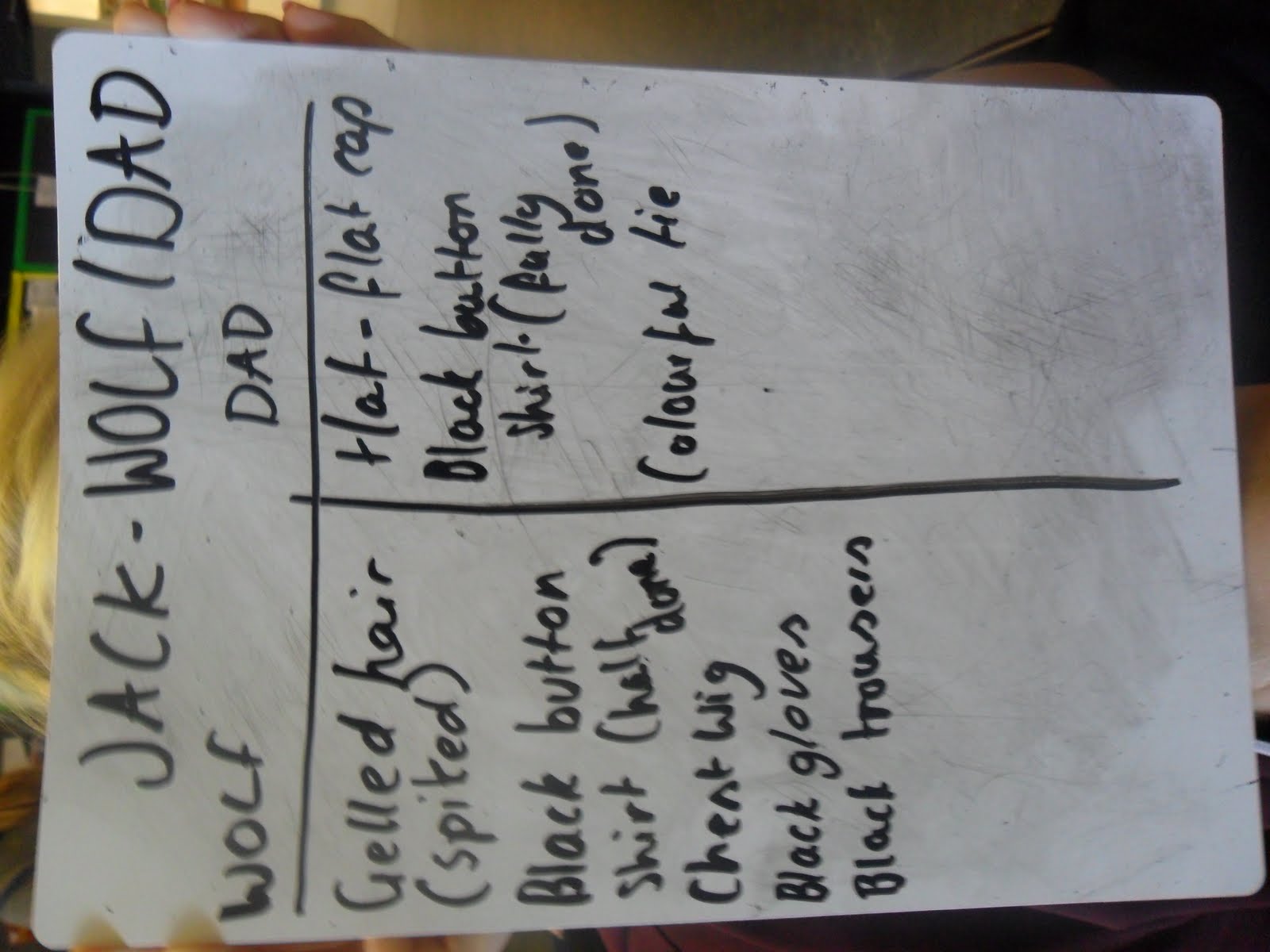
On Tuesday 19th April, Frankie and I with a little help from Jack came up with some costume and set design ideas.  We drew these on a white board so we could rub it off and draw another and correct it easily instead of doing it on paper.  We then took photo’s of the board so we had a record of the design.  We first discussed the set as we had mentioned having an invisible boarder for the two separate worlds of the narrators and the actors but we weren’t sure how to represent this.  We talked about having a rail or something but Frankie correctly pointed out that if we put it in the middle of the space, we would be blocking half of the space from some of the audience.  We then discussed the idea of having the rail at the back facing front with some basic set on it.  We then decided it would be easier if we had cloth with the setting painted on it and then turn it around and have another setting on the back.
This is what we came up with.


We also thought about the costumes for the characters.  We drew up some ideas on the whiteboard.

This is Little Red’s costume design.  She will wear a skirt and leggings with a girly cardigan at the start to please her dad who is against girls being tomboys.  When she leaves the house and enters the woods putting on some trainers, taking the cardigan off to reveal and sports top and wrapping it round her waist, she will roughly tie up her feminine hair and mess up her face in some way such as putting a bit of mud on or roughly removing her make-up.


This is the wolf/the dad’s costume design.  When he is the dad, he will have a flat cap on, a black button up shirt done all the way up, black trousers and a colourful tie.  When he is the wolf, he will take off the cap to reveal spiked up hair and take off the tie.  He will undo the top few buttons of his shirt and will have a chest wig on underneath and wear black gloves.


This is Olly’s costume design.  He goes into the story as a woodcutter so we decided that Olly would have a simple black overcoat on with jeans, a check shirt and braces underneath and black boots.  We agrees that I should have the same on not only to match but also to show that boys and girls can wear the same clothes and that fashion isn’t masculine or feminine. 


So this is my costume board.  It is basically the same as Olly’s.  We will be wearing the same clothes but just in a different way.


I quickly drew up a plan of the layout of the stage so we knew whether the set would be blocking any of the actors.

Tuesday, April 19, 2011

New Promo Photos

On Tuesday 19th April, just before our music lesson, Frankie, Olly, Jack and I went outside to take some more promo shots we could use in posters and a programme.  We used the collection of trees just outside the music block because it would look a bit like a forest opening which is appropriate for the setting of our play.
                             
First, we took an individual shot each of the wolf and Little Red in the woods as this is the main setting of the play and also where the two characters meet.


We then decided to get a shot of Little Red on her way to the woods, walking along the path in her hoody in an industrial looking area which goes against the stereotype.

We next decided to get a couple of group shots in the woods showing the sly wolf, careless Little Red and the overlooking narrators.


Next, we got a couple of shots of the narrators by themselves, back to back with a tree in-between.  Olly had a scared impression and I was careless and a little exasperated about his fear.  Again, this was to go against the stereotype and it is an underlying theme in the play that Olly assumes females to be frail and easily scared and girly and I contradict him every time; in fact, there is a part where Olly gets scared whilst I just watch the action calmly.


Finally, we got a group shot on some grass in front of a building as the scene was not set in the woods.  It shows Olly, who is the woodcutter in this scene barging into the house and the wolf being terrified whilst Little Red watches calmly and I stand annoyed at the side, exasperated at the fact that Olly assumes Little Red needs protecting.   I am planning to change the background on this photo but I am currently unsure as to what.

Sunday, April 17, 2011

Promo Poster: Abi vs Olly

I have made another promotional poster using a picture of Olly and myself.  I tried to keep the black and red theme I had established in the first poster and also the dark edge it had to it.  If I was to make another, I think I would try to show the fact that it was quite comedic as it just looks a bit dark at the moment.  I would like to take some more photos on Tuesday so I have more to work with.  Again, I will post this on my Facebook and tell my friends in hope it will recieve some feedback.  I will also email Jack, Frankie and Olly again.

Building a Character-Constantin Stanislavski, Chapters 1-6 Review

 Building a Character – Constantin Stanislavski
1950 – Methuen & Co. Ltd.

Chapter 1
Key Quotes:
“If you do not use your body, your voice, a manner of speaking, walking, moving, if you do not form characterization which corresponds to the image, you probably cannot convey to others it’s inner, living spirit”, page 5.
“Externally, it is not difficult to disguise yourself”, page 6.
Overview:
In the first chapter, Stanislavski talks about his teacher, Tortsov making changes to his physical appearance and how it changes how everybody see’s him for example, when he squints his eye, Stanislavski says he didn’t see Tortsov, but a man with “knavery, slyness, grossness”, but once he abandoned the trick, he was normal and ‘recognisable’ again.  He also says that it’s difficult to change your physical appearance and for people to see the ‘real inner you’.
Chapter 2
Key Quotes:
“Who is he? Who is he?” page 14.
“Only those material things could prompt me to find what I had subconsciously been searching for”, page 14.
Overview:
In the second chapter, Stanislavski is finding a costume for a masquerade the class is participating in.  He chooses one but by the time the masquerade comes about, he still hadn’t figured out ‘who’ his character was as this was also part of the assignment.  He decided to give in and not go up onto the stage with the rest of the class to be checked and started removing the make-up he had on but the make-up remover ended up smearing it all over his face and fake beard and hands.  He automatically changed his posture and got a cane.  He had found his person.  He went up onto the stage and gave a brilliant performance.  He described the experience as splitting his personality in half, instead of fully becoming the character, his ‘real seal’ spectator whilst the character controlled his actions and speech. 
Chapter 3
Key Quotes:
“The human being that you are is far more interesting and talented than the actor”, page 24.
“But they do not contain the essence of a character and they are not individualized”, page 27.
Overview:
In the third chapter, Tortsov gives everybody feedback on their masquerade character.  He explains that you must love the role in you, not you in the role.  He also says that you can play a general military person for example but by giving them a name and a proper job title and unique gestures, you begin to find the essence of the character. He says that people can show their best and their worst traits of their personality when hidden behind their character but cant without the mask.
Chapter 4
Key Quotes:
“We need strong, powerful bodies, developed in good proportions, well set up, but without any unnatural excess”, page 39.
“The actor cannot stop to think, to doubt, the weigh considerations, to make ready and test him.  He must act, he must clear the jump at full gallop”, page 40.
Overview:
Chapter 4 is all about posture and being physically ‘correct’ to be an actor.  Tortsov talks about professional athletes and how their physique isn’t ideal for an actor.  He also talks about how dance and gymnastics can correct physical flaws such as open the hips so the toes point outwards and broadening the gestures and finishing them properly.  Stanislavski also talks about his uncle visiting who is an actor and he comes with a fellow actor with whom he has a silent dispute with, using no words but tiny, almost unnoticeable finger twitches and movements.
Chapter 5
Key Quotes:
“In other words the left foot transfers the body weight at the same time that the right one takes it over”, (while talking about the incorrect way of walking) page 57.
“The things they used to do instinctively, now required the most conscious supervision and revealed how ignorant of anatomy and the locomotor muscles they were”, pages 58-59.
“I was learning how to walk.   But it was very difficult”, page 60.
“External plasticity is based on our inner sense of movement and energy”, page 71.
Overview:
Chapter 5 is Tortsov teaching his class fluidity in movement.  He has them take ballet lessons and acrobatics as some of their postures are wrong.  It is a continuation of chapter 4 but develops from being physically ‘correct’ statically but to in movement as well.  He inspects the way they walk.  None are correct.  Briefly, the correct way to walk is to swing your leg forwards, adjust its alignment with the knee, place the foot on the ground heel first and transfer the weight all the way down the foot until you are balancing on your big toe.  There should be a brief moment of floating before the other leg repeats this process.  He was also teaching them to move their arms, spine and legs fluidly.  He set a metronome on the slowest setting and every quarter beat; he moved a different part of his arm.  Elbow up first, then straighten the arm, raise the wrist and then the fingers and back down.  The students then did it and he broke down the counts so they had to do each part in smaller parts until the arm was moving fluidly.
Chapter 6
Key Quotes:
“Extra gestures are the equivalent of trash, dirt, spots”, page 73
“Every actor should so harness his gestures that he will always be in control of them and not they of him”, page 73
“An excessive use of gestures dilutes a part as water does goo wine”, page 74.
Overview:
Chapter 6 is all about restraint and control.  Tortsov tells the class about a conductor of an orchestra who with delicate touches of the baton drew out everything possible out of the instruments and the souls of the musicians as apposed to wafting his arms around which doesn’t have the same affect.  He also told of an art teacher who when he looked at a students piece of work, he saw nothing, it didn’t ‘speak’ to him so he took a paint brush and dabbed a tiny bit of paint on a blank piece of the canvas.  Suddenly, it came alive.  “Art begins with the slightest of touches”, he said.  This can also be applied with drama, music and dance.